
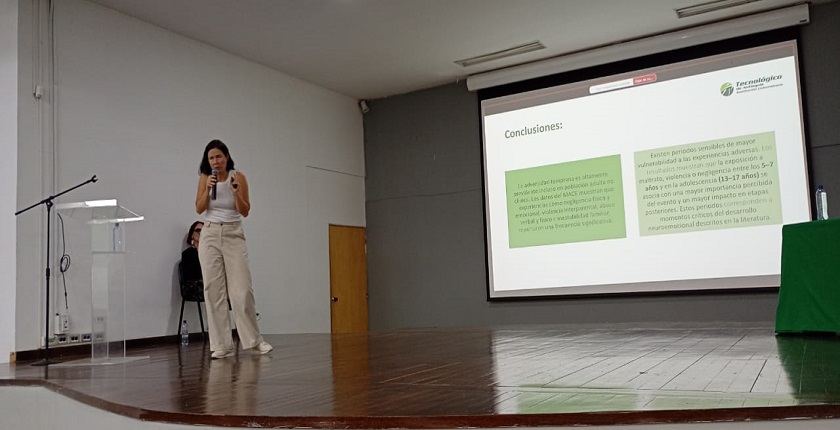
Faculty members from the Psychology program, Esteban Meneses Suárez and Natalia Gómez Cardona, represented the Fundación Universitaria María Cano at the International Clinical Symposium held at the Institución Universitaria Tecnológico de Antioquia.
In this academic setting, the faculty presented two papers. The first, titled “Clinical Case Presentation from a Psychodynamic Approach,” offered a reflection on the relevance and continued significance of psychodynamic clinical practice in addressing current challenges in mental health. The presentation highlighted the value of the clinical case as both a formative tool and a privileged pathway for understanding the complexity of psychic processes beyond immediate symptomatic expressions. From a contemporary psychodynamic perspective, it underscored the importance of analyzing the therapeutic relationship, working with transference, and recognizing the analyst’s containing function—central elements in fostering emotional integration, strengthening ego cohesion, and promoting clinically meaningful change. The presentation emphasized that psychodynamic psychotherapy remains a fundamental resource for studying and treating human suffering, particularly in cases involving experiences of emptiness, subjective fragility, or difficulties in affect regulation. Its contribution lies in offering a space for reflection, containment, and elaboration that is essential in current clinical practice.
The second presentation addressed the topic “Relationship Between Cognitive Biases and Early Adversity in the Colombian Population.” It shared the results of a study showing how exposure to early adverse experiences in childhood—such as physical neglect, parental physical abuse, interparental violence, and emotional neglect—can lead to long-term consequences in adulthood, including the presence of cognitive biases. These biases reflect distorted interpretations of everyday situations, influenced by emotional factors, catastrophic perceptions, generalizations, and more. The study’s findings confirm that certain developmental periods—particularly between ages 5 and 7, and 13 and 17—present greater neuropsychological vulnerability. Experiencing traumatic events during these sensitive stages significantly increases the risk of later mental health difficulties.
The event featured international speakers, professionals from various health institutions, and Psychology students, creating a space that fostered knowledge exchange and interdisciplinary dialogue on mental health. It strengthened academic collaboration, enhanced the visibility and positioning of the Psychology program and the Fundación Universitaria María Cano, and contributed to the generation and updating of knowledge in the field of mental health.
#MásMaríaCano