
Blog
RIICS Journal: How reliable is a test for assessing scapular movement in beach tennis?
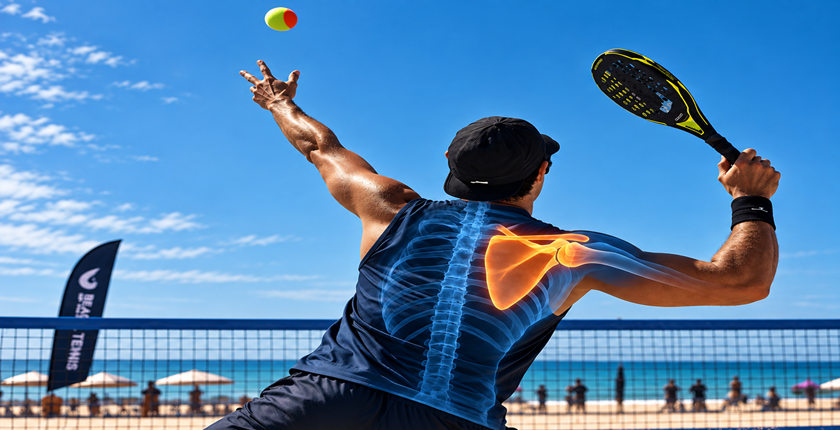
Beach tennis combines movement on sand with repetitive overhead arm actions, such as serving, smashing, and striking the ball. These physical demands make it important to assess how the scapula, commonly known as the shoulder blade, moves during athletic performance. However, for a clinical test to be useful, its results must remain consistent when the assessment is repeated or when it is performed by different evaluators.
A group of researchers examined the reliability of a clinical test for scapular dyskinesis specifically in beach tennis athletes, a population in which the test’s reliability had not previously been documented. The study included 58 trained and highly trained athletes. Two evaluators, one novice and one experienced, analyzed video recordings and classified each scapula as normal, mildly dyskinetic, or clearly dyskinetic. In addition, the novice evaluator repeated the assessment after 21 days.
The results showed that when the same evaluator repeated the test, the classifications were similar in most cases for both the left and right scapulae. However, when the evaluations conducted by the novice and experienced evaluators were compared, the level of agreement varied according to the side assessed. Agreement was low for the left scapula and moderate for the right. For the left side, the agreement estimate was also imprecise. According to the authors, differences between evaluators may be related to factors such as the interpretation of the mild dyskinesis category and the level of evaluator training.
These findings suggest that the test demonstrated substantial consistency when repeated by the same evaluator, but variable agreement between different evaluators. The authors recommend that future studies include larger and more diverse samples and explore more comprehensive training strategies for professionals performing these assessments.
The study does not establish the diagnostic validity of the test nor its ability to predict future injuries. However, it contributes valuable evidence regarding the use of scapular dyskinesis assessment in beach tennis athletes and highlights the importance of evaluator preparation in achieving reliable clinical results.
#MásMaríaCano